Saffron costs more than gold by weight
Open a jar of saffron and the first thing that hits you is the price. A gram of the good Iranian or Spanish stuff runs more than a gram of silver and, in bad harvest years, more than gold. There is no synthetic substitute that holds up under heat. There is no scaling trick that makes it cheaper. The cost is the work, and the work has not changed in three thousand years.
What it actually is
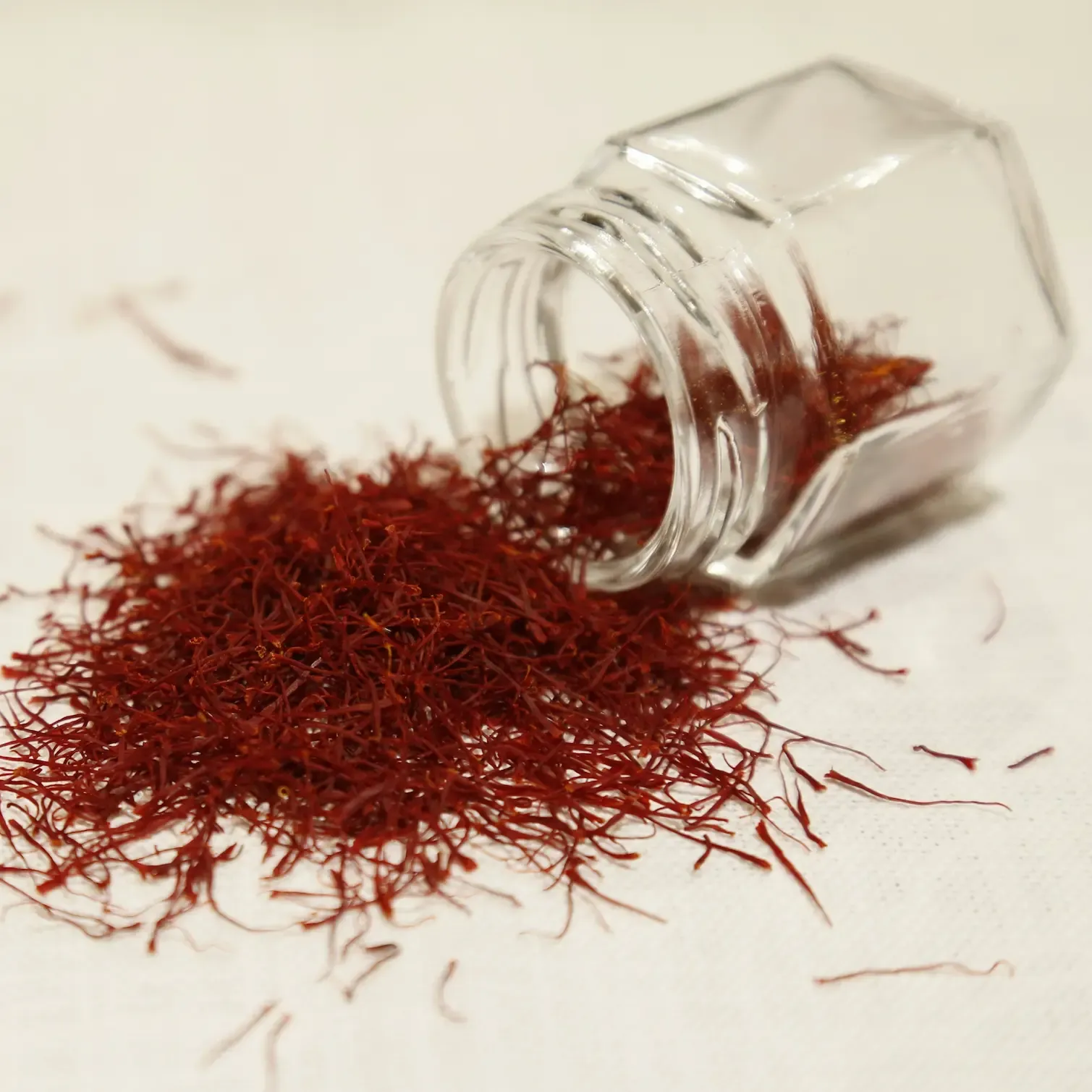
Saffron is the dried stigma of Crocus sativus, a small purple-flowered autumn crocus that grows from a corm. Each flower produces exactly three crimson stigmas at its centre. To make one kilogram of finished saffron you need somewhere between 150,000 and 200,000 flowers, and the flowers must be picked at dawn — once the sun rises, the stigmas wilt and lose colour. Then someone has to sit and pull the three threads out of every single bloom by hand. A skilled picker working a full morning produces maybe sixty grams of fresh stigmas, which dries down to about twelve grams of spice.
This is not a problem that mechanises. The flower is too delicate, the threads are too fine, and the rest of the bloom is worthless. Every gram you buy is a small monument to a person bending over a basket at sunrise.
How long this has been going on
The earliest depictions are on the walls of Akrotiri on the Greek island of Santorini, painted around 1600 BCE — frescoes of women plucking crocuses, threads in hand. The Minoans on Crete used it for medicine, dye, perfume, and cooking. The Greeks, Romans, Persians, Phoenicians, and Egyptians all traded it. Cleopatra is said to have bathed in saffron-infused milk before receiving visitors, partly for the colour, partly because the stuff was a working-class flex of how rich you were.
The medieval European saffron market was lucrative enough to produce its own crime wave. In the fourteenth century a court in Basel sentenced people to death for "saffron adulteration" — bulking it out with safflower, marigold petals, or dyed threads. The "Saffron War" of 1374 in Switzerland was fought over an eight-hundred-pound shipment.
What you are actually paying for
Three compounds are doing most of the work. Crocin is the carotenoid that gives saffron its colour — the same family of molecules as the orange in carrots. Picrocrocin is the bitter that gives it bite. Safranal is the volatile that gives it the smell: hay, honey, and something faintly metallic.
When you steep saffron in warm water or stock, the crocin dissolves first and dyes the liquid a deep orange-gold within a few minutes. The aroma compounds need a bit longer. This is why most recipes call for blooming saffron in a small amount of warm liquid before adding it to the dish — you are pre-extracting the colour and the volatiles so they distribute evenly.
A common mistake is to use too much. A good pinch — fifteen to twenty threads — flavours a paella for four. Double that and the dish turns medicinal and bitter. Saffron is supposed to whisper, not shout.
Where it comes from now
Iran produces somewhere around 90% of the world's saffron, most of it from the Khorasan region in the northeast. Spain, Greece (especially Kozani in Macedonia), Italy (Abruzzo), and Morocco produce the rest. Kashmir grows a smaller amount of an exceptionally pigmented variety. The "Spanish" saffron in most supermarkets is often Iranian saffron repackaged in Spain — the country exports more than it grows.
Real saffron threads are deep red with a slight orange tip and they bend without breaking. If your threads are uniformly orange, brittle, or shed a lot of yellow dust, you are looking at safflower or turmeric — the two most common fakes.
Why it's worth it
You only need a little. A two-gram tube — at first glance an obscene price for what looks like dead grass — flavours a dozen large dishes. Spread across a year of cooking the cost-per-meal is trivial, and the colour and aroma it gives to a risotto, a paella, a fish stock, or a sweet milk pudding cannot be replicated by anything else on the spice rack.
Saffron is one of the few foods where price is honest. The flowers are real. The dawns are real. The bent backs are real. You are not paying for marketing or a clever bottle. You are paying for the labour of pulling a tiny red thread out of an autumn flower, 150,000 times.