
Why eating with your left hand is taboo in half the world
Across the Middle East, South Asia, and large parts of Sub-Saharan Africa, the left hand is the hand used for personal hygiene — specifically, for cleaning oneself after using the toilet. In a pre-toilet, pre-running-water context, this created a functional division of labour between the two hands: the right hand was clean and used for eating, greeting, giving and receiving objects; the left was dirty and kept away from food and shared surfaces.
The practical origin
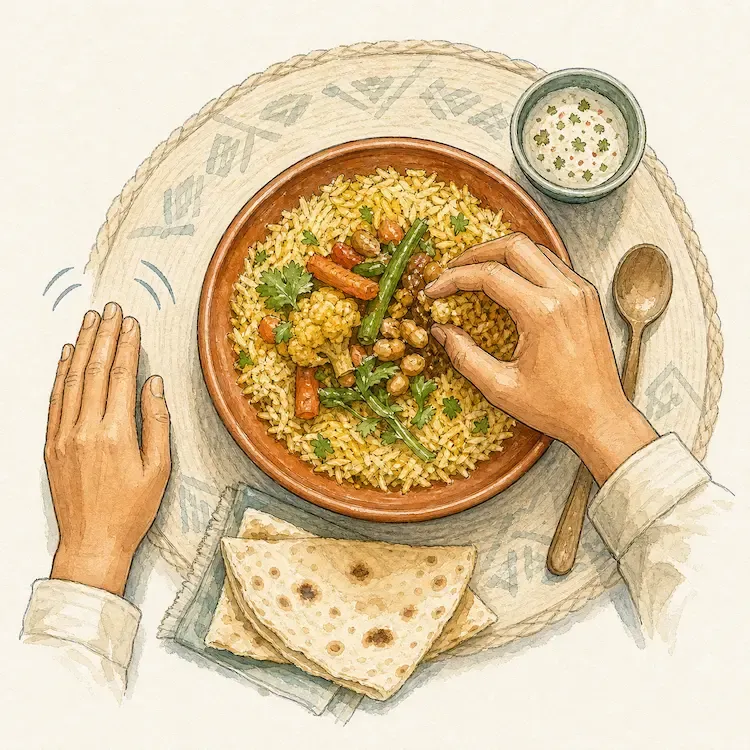
In cultures that traditionally clean themselves with water rather than paper after using the toilet, one hand pours and one hand cleans. The left hand was conventionally assigned the cleaning role, leaving the right hand clean for everything else. This is a sensible hygienic solution in conditions where soap and running water are not available immediately after. Cross-contaminating the eating hand with the hygiene hand was a genuine health risk.
The distinction predates Islam but is strongly reinforced by it. Hadith traditions attribute to the Prophet Muhammad clear instructions to eat and drink with the right hand and to use the left for personal hygiene. For Muslims following Sunnah practice, eating with the left hand is not merely rude — it violates a specific religious directive. Similar conventions appear in Hindu practice, where the left hand is associated with impurity, and in various African and Asian cultural traditions that developed independently.
What happens to left-handed people
The taboo creates a genuine challenge for people who are naturally left-handed. In cultures where the prohibition is strong, left-handed children are typically trained to eat with the right hand regardless of their dominant hand. In some traditional contexts, being observed eating with the left hand as an adult signals either foreignness, bad upbringing, or disregard for social rules — any of which could cause significant offence.
In modern urban settings, particularly in more secular or cosmopolitan contexts, the strictness of the prohibition varies. Many younger or more internationally exposed people follow the convention selectively or not at all. But in conservative religious contexts and in rural communities where traditional practice is maintained, the right-hand rule remains firm.
The Western context
Western culture has its own version of handedness taboos at the table, though they are less absolute. Passing salt to the left, crossing arms to receive wine, serving from the left and clearing from the right — European table manners have a complex set of directional conventions, most of them lost to general awareness now but still observed in formal service. The common thread is that hand and direction conventions around eating tend to acquire cultural weight beyond their practical origins.
Eating with hands as skilled practice
Separate from the left-hand prohibition, eating with hands in cultures that practise it is a skilled activity, not simply a lack of alternative. In South Indian and Sri Lankan eating culture, food is mixed and shaped into balls or scoops using the fingers with considerable dexterity. In Ethiopian cuisine, injera — the sourdough flatbread — is used as both plate and utensil, torn and used to scoop stews. In all these traditions, the right hand only is used, and the technique required is learned and refined rather than improvised.
The Western fork is not the universal endpoint of table technology evolution — it is one solution to eating, developed in one cultural context, that became globally dominant partly through colonialism and partly through the association of European table manners with modernity and prestige.